

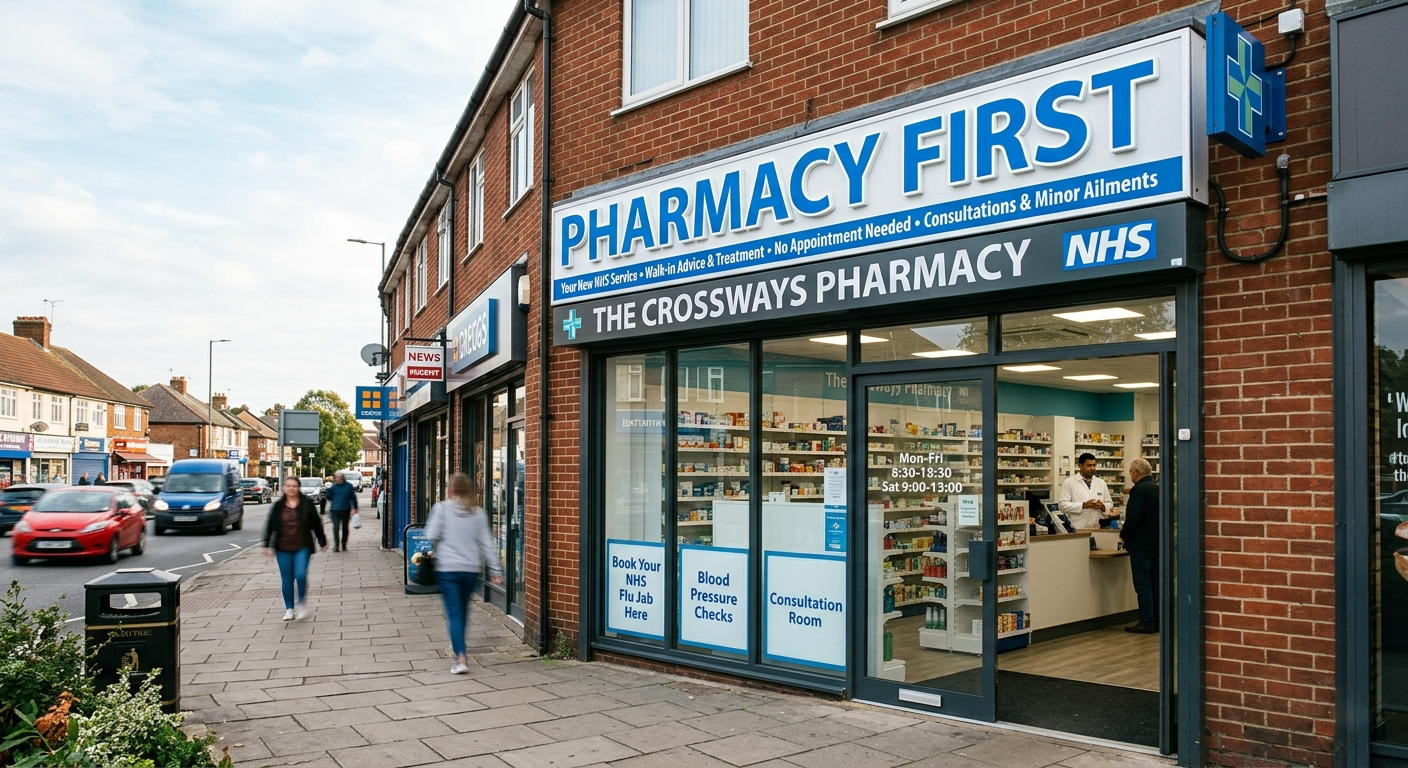

Community pharmacy is undergoing one of its most significant transformations in recent memory. The Pharmacy First service, which launched on 31st January 2024, represents a genuine shift in how the NHS views community pharmacy, positioning it as the true first port of call for patients seeking healthcare advice. If your pharmacy isn’t yet offering this service, here’s a comprehensive guide to getting set up.
What is Pharmacy First?
The Pharmacy First service is an Advanced service that involves pharmacists providing advice and NHS-funded treatment, where clinically appropriate, for seven common conditions: sinusitis, sore throat, earache, infected insect bites, impetigo, shingles and uncomplicated urinary tract infections in women.
The service also incorporates the elements of the previous Community Pharmacist Consultation Service (CPCS), covering minor illness consultations and the supply of urgent medicines following electronic referrals from NHS 111, general practices and other authorised healthcare providers.
In essence, Pharmacy First enables trained pharmacists to assess patients, follow structured clinical pathways and supply prescription-only treatments under a Patient Group Direction (PGD), all at NHS expense.
Step 1: Sign up via the MYS portal
The first practical step is registration. Pharmacy owners must notify NHS England of their intention to provide the service by completing an electronic registration through the NHS Business Services Authority’s (NHSBSA) Manage Your Service (MYS) portal.
Step 2: Ensure you have a compliant consultation room
Pharmacies must have a consultation room used for the provision of the service which meets the requirements of the terms of service. There must also be IT equipment accessible within the consultation room to allow contemporaneous records of consultations to be made within the NHS-assured Pharmacy First IT system.
If you’re considering offering remote consultations, note that clinical pathway consultations can only be conducted via good quality video, they cannot be provided by telephone or audio consultation alone. The acute otitis media (AOM) pathway is excluded from remote provision entirely, as it requires otoscope examination.
Step 3: Get the right equipment
All pharmacies providing the service (except distance selling pharmacies) must have an otoscope, as ear examinations are required within the acute otitis media pathway. Guidance on selecting a suitable otoscope can be found in Annex C of the service specification.
Beyond the mandatory otoscope, it’s worth considering a thermometer, tongue depressors, and a small torch to assist with throat examinations under the sore throat pathway.
Step 4: Choose an NHS-assured IT system
An NHS-assured Pharmacy First IT system must be used, meeting the minimum digital requirements specified within the Community Pharmacy Clinical Services Standard and including an API to facilitate transfer of data into the NHSBSA MYS portal.
The four current approved suppliers are HxConsult (Positive Solutions), Pharmacy Manager (Cegedim), PharmOutcomes (Pinnacle Health) and Sonar Health (Sonar Informatics). These systems handle clinical record-keeping, automatically send post-event messages to the patient’s GP practice, and populate your MYS payment claims via API.
Step 5: Ensure pharmacist competency and complete training
The pharmacy owner must ensure that pharmacists providing the service are competent to do so, including in the use of an otoscope, and are familiar with the clinical pathways, clinical protocol and PGDs. Documentary evidence that staff are competent and remain up to date must be kept.
The Centre for Pharmacy Postgraduate Education (CPPE) has developed a Pharmacy First self-assessment framework in partnership with NHS England, which pharmacists can use to identify gaps in their knowledge. Additional training is available from providers such as Agilio iLearn and Health Academy.
Step 6: Put your SOPs in place
Pharmacy owners must have a Standard Operating Procedure (SOP) for the service, which all staff participating in provision of the service must be familiar with and follow. The SOP must include the process for escalation of any clinical and non-clinical issues, and the pharmacy must have available signposting details for other local services, contact details for local out-of-hours and urgent care providers and contact details for the local Integrated Care Board (ICB).
CPE provides helpful templates including a key contact details document and a GP referrals summary template to get you started.
There are 23 PGDs and one protocol for the service, authorising supply of medicines at NHS expense. Pharmacists working under the PGDs and an authorising manager need to sign them before use. A master authorisation sheet is available to sign all 23 PGDs and the protocol in a single document. Don’t overlook this step, as you cannot legally supply medicines under the service without it.
Step 8: Build relationships with local GP practices
Referrals from GP practices are central to maximising the service’s impact. If the Pharmacy First service is to deliver the maximum possible benefit to patients, the NHS and community pharmacies, it is important that there is a strong relationship between community pharmacies and local general practices.
CPE offers a range of resources to help, including a template email/letter to GP practices, a checklist for promoting the service to GPs, and even a PowerPoint presentation for use at practice meetings.
A note for Distance Selling Pharmacies (DSPs)
DSPs can provide the Pharmacy First service but are limited to six of the seven clinical pathways, the acute otitis media pathway is excluded as it requires otoscope examination. DSPs cannot provide consultations face-to-face and must make arrangements for prompt delivery of any medicines supplied, at no cost to the patient.
Ready to get started?
Use CPE’s dedicated implementation checklists, one for pharmacy owners and one for pharmacists, to work through each step methodically. For the full service specification, clinical pathways, and PGDs, visit the NHS England publication page.
Pharmacy First is one of the most significant expansions of community pharmacy’s clinical role in a generation. Getting set up properly means your team can deliver genuine patient care, ease pressure on GP surgeries, and position your pharmacy as an indispensable part of the local healthcare network.
For the latest updates, FAQs, and myth-busting resources, visit Community Pharmacy England’s Pharmacy First page.