



For community pharmacies across the UK, engaging with the public and promoting your services is essential, but promoting medicinal products requires navigating a rigorous regulatory landscape. While the goal of communicating healthcare information is shared with Ireland, the specific legal framework and enforcement bodies in the UK are distinct.
The core regulations are governed by the Human Medicines Regulations 2012 (SI 2012/1916) and are enforced by the Medicines and Healthcare products Regulatory Agency (MHRA). Furthermore, industry codes, notably those from the Proprietary Association of Great Britain (PAGB), set the standard for consumer advertising of over-the-counter medicines.
Failing to adhere to these rules can lead to significant consequences, including mandatory ad withdrawal, public reprimand and even criminal prosecution. Here is an essential GUIDE for UK pharmacies.
The fundamental distinction: Prescription-only vs. over-the-counter
The single most important rule is the absolute divide based on a medicine’s legal classification:
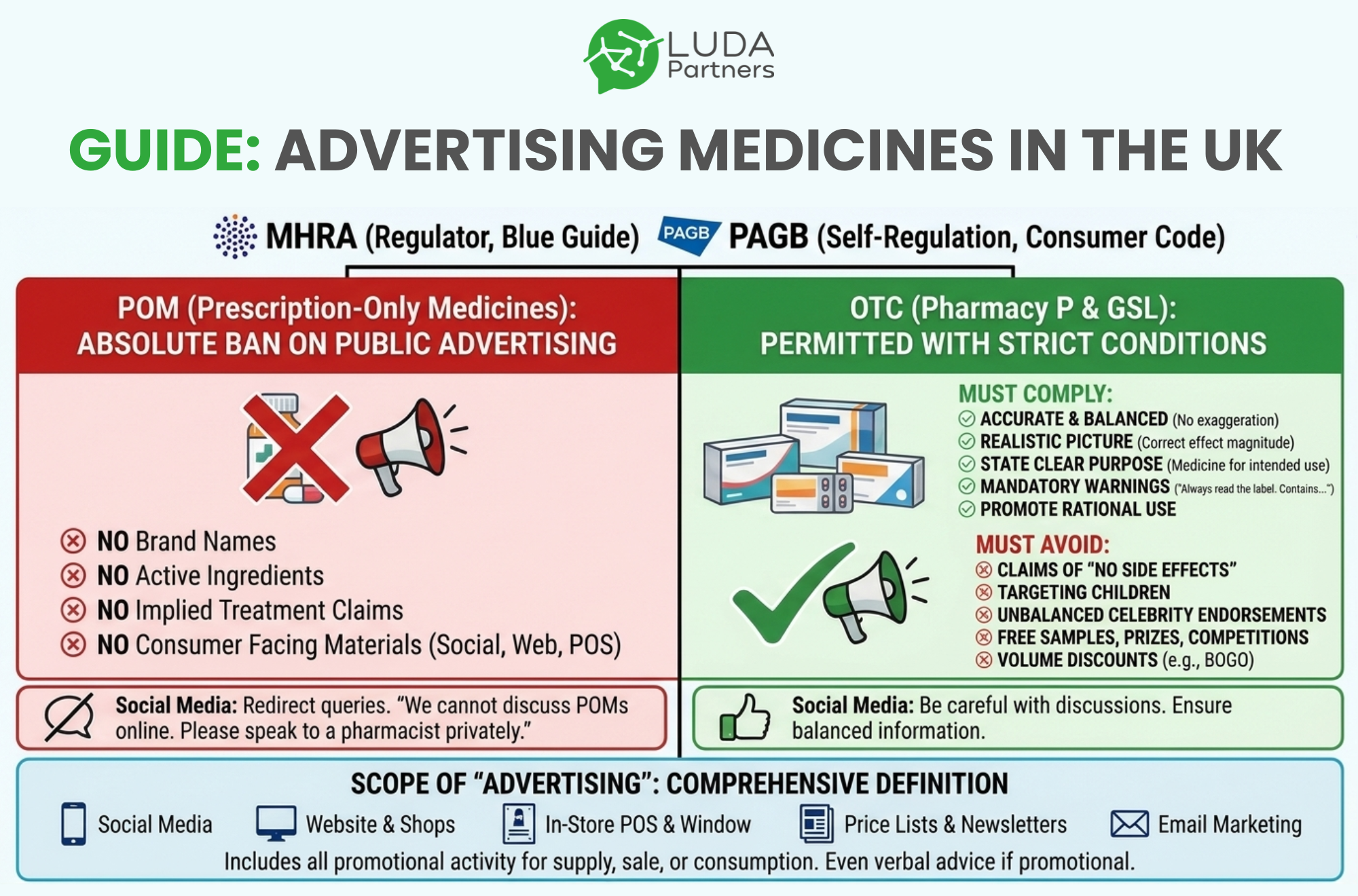
- Prescription-Only Medicines (POMs): It is an offence to advertise prescription-only medicines to the general public. This is a strict prohibition. You cannot mention brand names, active ingredients or even imply that a prescription medicine could treat a condition in any consumer-facing materials (including social media, websites, window displays or emails).
- Pharmacy (P) Medicines and General Sales List (GSL) Medicines: These over-the-counter (OTC) medicines can be advertised to the public, but the content must comply with strict statutory and self-regulatory standards.
What constitutes «Advertising»?
The definition of advertising is comprehensive. It includes any activity designed to promote the prescription, supply, sale or consumption of a medicine.
This encompasses virtually all communication channels:
- Social media (posts, stories, reels and even ‘likes’ or ‘shares’ that promote a product).
- Pharmacy websites, online shops and product pages.
- In-store point-of-sale (POS) materials, posters and shelf-talkers.
- Window displays.
- Price lists and catalogues.
- Email marketing and newsletters.
- Even verbal advice can fall under this umbrella if it crosses the line into promotion.
Core principles for advertising OTC medicines to the public
If you are promoting a GSL or P medicine (e.g., a specific brand of paracetamol, hay fever relief or cough syrup), your advertising must abide by the Blue Guide (MHRA’s guidance) and the PAGB Consumer Code.
Your content MUST:
- Be accurate: It cannot mislead or exaggerate. If you promote a benefit, you must also clearly communicate any critical limitations or potential issues.
- Present a realistic picture: You cannot use images or text that mislead the consumer about the magnitude of the effect or the speed of action.
- State the clear purpose: The advertisement must make it clear that the product is a medicine and what its intended use is.
- Include mandatory warning statements: Every OTC advertisement must contain a clear, legible invitation to read the label and follow the instructions. (e.g., «Always read the label. Contains [Active Ingredient].»). For specific ingredients, additional mandatory phrases may be required (e.g., about drowsiness).
- Promote rational use: The goal must be to ensure the medicine is used correctly.
Prohibited content and tactics in consumer advertising
Certain practices are strictly banned to prevent the «irrational use» or inappropriate sale of medicines:
- It is forbidden to claim that a medicine has no side effects or that its safety is «guaranteed.»
- Advertising must not be primarily directed at children (under 16), nor should it encourage children to buy or use medicines.
- You cannot use recommendations by celebrities or scientists that suggest the product should be used regardless of medical advice. Consumer testimonials must be genuine and balanced.
- You cannot offer free samples of medicines, prizes or entry into a competition as an inducement to purchase or use a medicinal product.
- «Buy one get one free» (BOGO) or other volume-based discounts that encourage over-purchasing are prohibited for medicines.
Social media: A critical compliance area
Social media is a common area for accidental breaches. The MHRA and PAGB have specific guidance for this:
Key rule for UK pharmacy social media: Do not engage in specific brand conversations with customers online regarding POMs. If a customer comments asking about a POM treatment for a condition, you must redirect them. The safest response is: «We cannot discuss specific prescription treatments online. Please speak to your GP or visit our pharmacist in-store for a private consultation.» For OTC medicines, discussions should be handled carefully to ensure they meet balanced information requirements and do not encourage inappropriate use.
Responsibility and guidance
The MHRA is the main regulatory authority and produces the essential Blue Guide: Advertising and Promotion of Medicines in the UK. The PAGB provides invaluable pre-vetting and guidance for its members on consumer advertising.
While the Superintendent Pharmacist ultimately holds responsibility for the legal operation of the pharmacy, including its marketing, ensuring all staff involved in social media and in-store promotion are trained on these rules is critical.
Summary checklist for pharmacy staff
| Regulatory checkpoint | Requirement |
| POMs | Absolute restriction: Zero public-facing advertising. |
| OTC (P/GSL) | Permitted, but must include: «Always read the label,» purpose and balanced info. |
| Price lists | Must only include essential factual details, not promotional copy. |
| Discounts/promos | No free samples, BOGOs, prizes or volume-based discounts on medicines. |
| Social media | Be professional. Focus on services. Refer customers asking about POMs to private consultations. |
| PAGB pre-vetting | Strongly recommended for any significant consumer campaign. |
Ensuring compliance protects patient safety, maintains public trust in the pharmaceutical profession and safeguards your pharmacy from regulatory and legal action. When in doubt, focus your outreach on health services (e.g., smoking cessation clinics, travel health advice or the Pharmacy First service) rather than specific medicine brands.
For official guidance and detail, always consult the MHRA Blue Guide on Advertising and Promotion.